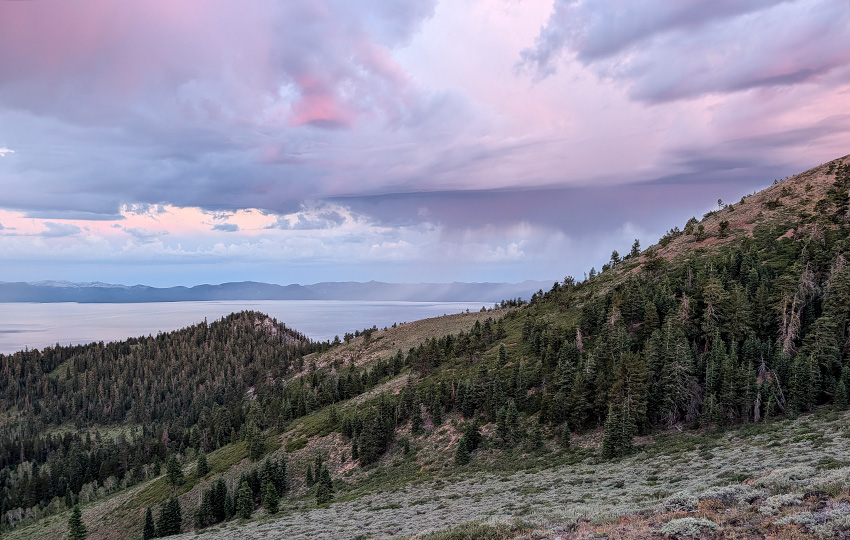
“Having stomach problems last couple of hours, trying to work through it, good chance I’ll be later than 1am,” read Dave’s text.
Eight weeks prior, Dave asked me to be one of his pacers during his 100-mile Tahoe Rim Trail Endurance Run (aka TRTER100, July 18-19). So I was on my way to link up with him when he reached out.
The plan was for me to drive up from my home in South Lake Tahoe to Incline Village, NV, and meet him at the Diamond Peak Ski Resort aid station. This was the 74-mile marker of the race. He originally estimated that he’d arrive around midnight. Then, once he finished resting, I’d run with him the remaining distance of the race. This would be about 28 miles because the total distance was actually 102 miles.
Since I was meeting him so late, we’d mostly be running through the night. This would be ideal, actually, because it reaches the high 90s by midday in Carson City, NV, where the finish line is located. So the earlier you can finish on day number two, the better.
Support Tahoe Trail Guide with a financial contribution via PayPal (single contribution) or Patreon (reoccurring contributions). Your support of Tahoe Trail Guide is very much appreciated!

Although this experience was new to me, Dave’s been running endurance races (and pacing others) for a number of years. So this type of late night rendezvous and then running through the night was pretty standard stuff for him. In fact, he actually completed this same race in 32 hours, three years ago. That was his first time running it. However, he DNF’d (did not finish) in his second attempt due to similar stomach issues.
Since becoming a trail runner, Dave has discovered that he struggles with keeping anything down after a certain amount of effort and miles. That includes both food and water. Not an easy thing to deal with when you’re trying to run 100 miles! So, he’s spent the past two years working on fueling (i.e. eating and drinking) in an effort to minimize and/or eliminate his stomach problems. He thought he solved his personal mystery by now, so his goal for this third time around was to break 30 hours.
But based on his text and having tracked him all day via the race app, he was clearly running behind schedule. So, I was growing concerned. Basically, I was mentally preparing for the idea that I may just be making the hour-long drive to wish him better luck next year and then return home.
Self-Doubt
I was already nervous about this whole thing for multiple reasons. The first and foremost being that this would be the longest continuous effort that I’ve ever traveled on foot.
To be fair, I’m not exactly a couch potato. For example, I’ve run a couple of marathons (1998, 2001) and other foot races. I’ve bicycled the 500+ miles across the state of Nevada during a 5-day stretch (2007), which equates to five consecutive centuries. Additionally, I’ve thru-hiked the Appalachian Trail (1999) and Tahoe Rim Trail (2014). And, I’ve toured various longer distances on cross-country skis, such as the 30km Great Ski Race (2019). So I’m no stranger to distance. But I’m a far cry from being any sort of elite athlete. And, when looking at those dates, it’s obvious that it’s been a while since I’ve logged big miles in any sport.
Furthermore, I’m fast approaching my 52nd birthday. That, and this year (2026) marks only my second season as a trail runner. Not to mention the fact that my longest run of the season (when Dave asked me to be his pacer) had only been 10 miles. And, even then, I developed a slight case of tendonitis in my left knee during that 10-miler!
How the heck was I going to run 28 miles, I wondered?
But Dave pushed back when I scoffed at the idea of being his pacer. “You’re going to be fine,” he said. “I’ve seen you progress a lot in a short amount of time. You’re a strong runner, and you have plenty of time to prepare.”
That “plenty of time to prepare” was no more than eight weeks. And, don’t forget that you need to set aside at least two weeks at the end of the training cycle for recovery before the actual event. So, I was basically planning for six weeks of solid running.
Again, how was I going to pull off 28 miles?!
Preparations
Buoyed by Dave’s confidence in me, which was way more than I had in myself, I began to prepare.
My plan for the summer, before being asked to pace him, was to start running the same weekly mileage and elevation as last year (2025). That target goal was at least 25 miles and 5,000 feet of elevation gain per week. But I knew that in order to perform adequately for the pacing event I’d have to exceed those numbers.
So, during the following eight weeks, I logged 285+ miles with 53,000+ feet of total elevation gain. Had I stuck to my original plan, I would’ve only run 200 miles with 40,000 feet of elevation gain. So this was fairly high mileage for me. Despite my increased efforts, though, I remained injury free.
I still worried that I hadn’t prepared enough, however.
Notable Efforts
My longest run had only been 17 miles, for example, during this training cycle. But that’s the way it was. I simply didn’t have enough time to add longer, individual runs. This is because, as a general practice, beginners should only increase their long runs each week by about 10% in relation to their last longest effort. Once they start arbitrarily bumping up the distance by multiple miles, for example, their risk for injury dramatically increases. This is especially true for older runners such as myself.
And, again, of those eight weeks I had to set aside the last couple of them for recovery. So, doing the math, increasing my last long distance (of 10 miles) by 10% each week doesn’t yield a very long single distance run at the end of those six weeks.
Therefore, I had to be creative during the build-up phase to add mileage. Believe it or not, during my last big week before tapering off, I actually managed to log 50+ miles. And, as Dave likes to say, “50-mile weeks are the building blocks of the universe.”
The most notable part of that 50-mile week was my variation for running more mileage without a “long” run. Again, I knew that I couldn’t just hammer out a single 20-miler. That was out of the question if I wanted to avoid injury. So, instead, I ran one shorter day to work and then four consecutive 10+ mile days. This enabled me to include recovery time in-between those moderate efforts. Therefore, I could still progressively increase the mileage and stress to my body in a compressed timeframe, but in a relatively safe manner.
Daily Grind
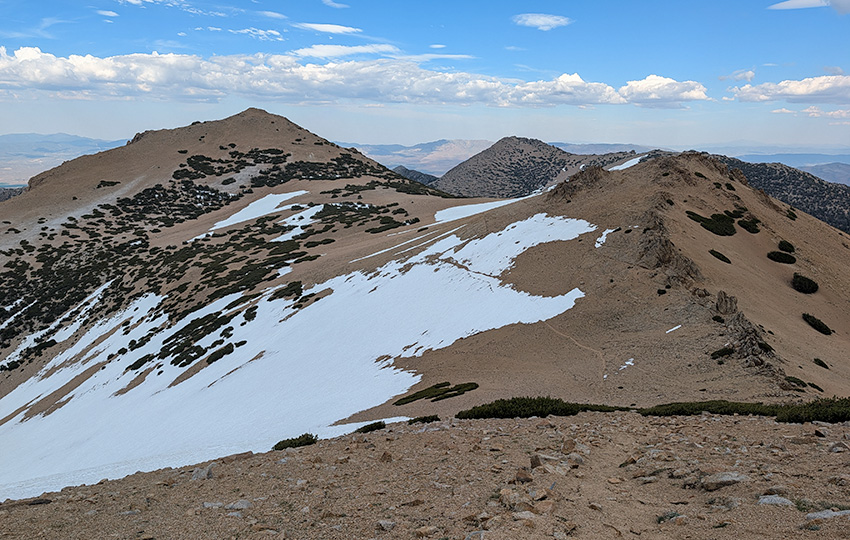
I should also mention that the majority of my training runs are commutes to and from my summer job. Although I don’t run every day, I do run three of my five days of work. The shortest one-way distance is 3 miles, which includes 1,100 feet of elevation gain (when going to work). To increase my overall mileage, however, I often tack on extra miles in either direction (or both). So, I run between 6-12 miles three times per work week. And then I run at least once more on my weekends, usually a longer effort.
Admittedly, these split runs were never part of any sort of master plan. But I’ve found that they’ve allowed me to add significant mileage with built-in recovery time. For me, this has been critical because I’ve always dealt with tendonitis due to pushing myself too much, too early. Just like that first 10-miler at the beginning of this season’s training cycle. Segmenting my running essentially allows my tendons and ligaments enough time to properly adapt to the increased stress.
Another benefit of the split running is that I’m on my feet and walking around all day at work. So, by bookending the workday with running, to some degree I’m simulating being on one really long run.
In the end, however, I just train as best I can with my available time and resources.
Training Weeks with Mileage and Elevation Gain
Here’s a breakdown of my weekly preparations for pacing Dave during his third attempt at the TRTER 100.
- 5/20 – 5/23 (18.58 mi/3,356 vert)
- 5/24 – 5/30 (25.71 mi/5,545 vert)
- 5/31 – 6/6 (31.26 mi/5,249 vert)
- 6/7 – 6/13 (32.06 mi/5,830 vert)
- 6/14 – 6/20 (35.18 mi/8,063 vert)
- 6/21 – 6/27 (40.69 mi/7,133 vert)
- 6/28 – 7/4 (51.66 mi/8,140 vert)
- 7/5 – 7/11 (32.76 mi/6,798 vert)
- 7/12 – 7/18 (19.82 mi/2,941 vert)
- 7/19 – Race Day! (29.00 mi/3,348 vert)
Total Preparation and Race Mileage/Elevation Gain = 316.72 miles/56,403 vertical feet
Additional Fears
Despite my training efforts, I was still concerned that somewhere in those 28 miles I’d experience my own catastrophic problem(s). A lot can happen over that amount of distance. A trip or a stumble, an inability to fuel myself properly, or a bout of gastrointestinal issues… My anxiety was high before meeting up with Dave because I didn’t want to sabotage his race by becoming a liability. Nobody wants to be that person, right?
That, and another fear that lurked in my mind was that I might actually have to convince Dave to quit at some point. If he couldn’t consume enough food or water, for example, he’d really be risking his health. There were some significant distances between the aid stations toward the end, which could make that call especially challenging. But that’s part of a pacer’s job. That is, to monitor and advise the primary runner whether they want to hear the feedback or not. That said, it’s no small task to tell a competitor to give up when they may not believe that they’re as bad off as they appear.
Again, I already had multiple reasons why I was internally freaking out about participating in this event. But now, with his text about stomach issues, I was beginning to stress a little more.
End of Part 1
I have a bad habit of letting my essays go on for too long, like this one. So I decided to split it up into two parts. The preparations for my experience as a pacer for my buddy Dave. And the next installment will be about the execution of those final 28 miles. Actually, it wound up being 29 miles, but who’s counting?! Haha 🙂
Stay tuned for My First Experience as an Endurance Run Pacer (Part 2): The Last 29 Miles of the TRTER 100.
Such an interesting experience! Just reading about all of the mental and physical challenges that need to be addressed beforehand is, in itself, exhausting! I look forward to the second part.
Thanks so much for the nice feedback, Joan. I appreciate it 🙂
It was definitely a unique experience building up to the event, and I look forward to sharing about the actual pacing and running 🙂
Really enjoyed this and looking forward to part 2. Training with a max distance of 18 miles and then doing a real 29 miler would mentally freak me out. Happy soon-to-happen 34th birthday!!
Haha! Thanks, Brad. I only wish I was going to be 34 again 😉
Yeah, I was definitely concerned about that much longer distance. Fortunately for me, I was linking up with Dave after 74 miles so we both knew that it would be much slower going.
Thanks for the nice feedback 🙂
Great read can’t wait for part 2.
Thanks, Matt! I appreciate the kind words 🙂